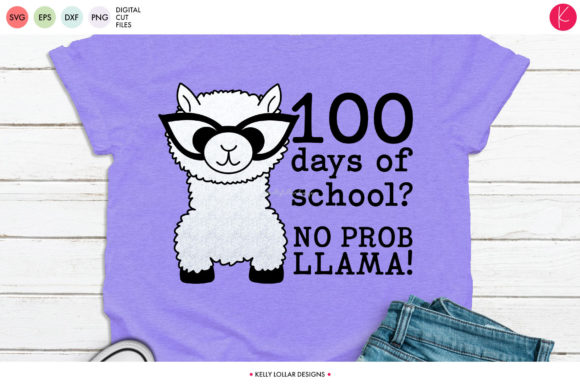
100 Days of School No Prob Llama
As a designer who’s stitched over 300 school-themed embroidery projects—from kindergarten tote bags to teacher appreciation sweatshirts—I opened the 100 Days of School No Prob Llama file with quiet curiosity, not hype. This isn’t just another cartoon llama; it’s a small, expressive design built around timing, tone, and real-world wearability. I tested it on a medium-weight cotton twill tote for a local preschool’s 100th Day celebration—and what emerged after stitching wasn’t just legible text and a smiling llama, but something that made parents pause, smile, and ask, “Where’d you get that?” That’s the first sign a design earns its place in your craft business or Etsy shop.
A Design That Feels Like a Conversation, Not a Decoration
The 100 Days of School No Prob Llama lands with gentle humor and confident simplicity. The llama wears glasses—subtle, round, and just detailed enough to read without becoming fussy. The “No Prob” phrase curves lightly beneath it, echoing the animal’s relaxed posture. There’s no overcrowding, no forced cuteness. As a machine embroidery design, it breathes: generous spacing between letters, open shapes in the llama’s ears and legs, and balanced negative space that prevents fill stitch saturation. That matters—especially when you’re stitching on baby onesies or tea towels where dense stitching can stiffen fabric or snag during washing.
Where It Shines (and Where It Needs Thought)
This design excels on custom apparel meant to be seen and appreciated—not hidden in a drawer. On a unisex crewneck sweatshirt? Perfect. The llama reads clearly at 3.5 inches wide, and the phrase stays legible even with moderate thread tension variance. As a tote bag design, it holds up beautifully across seams and handles—no distortion, no letter crowding. I also used it as an embroidered patch on a denim apron for a school bake sale volunteer; the satin stitch on the llama’s outline stayed crisp, and the running stitch details (like the tiny glasses frame) didn’t vanish into the texture.
But let’s be practical: this isn’t a one-size-fits-all embroidery file. On thin, stretchy jersey tees? Proceed with caution. The curved “No Prob” baseline and small eye details need solid stabilization—lightweight cutaway or tear-away works best, not basic iron-on. On dark fabric, contrast is key: light ecru or soft yellow thread lifts the llama gently without screaming; neon orange would overwhelm the mood. And if you’re planning to stitch it inside a curved cap bill or on a toddler’s knit beanie? Test first. The design’s clean lines hold up well—but only if your hoop size comfortably clears the outermost points of the llama’s ears and the tail’s curve.
What It Adds to Your Handmade Product—Beyond the Stitch
For Etsy sellers and small shop owners, the 100 Days of School No Prob Llama quietly elevates perceived value. It doesn’t shout “sale item”—it says “thoughtfully made.” Parents buying personalized gifts notice the care in the glasses detail. Teachers appreciate that it’s witty without being sarcastic. That nuance builds trust: when customers see consistency in tone and execution across your listings—whether it’s a pillow cover, a kitchen towel, or a holiday embroidery kit—they start associating your brand with warmth and reliability.
It also plays well in digital spaces. As a Graphics asset, it translates cleanly into printable mockups—no pixelation, no jagged edges. When previewed in black-and-white or grayscale, the hierarchy remains clear: llama first, phrase second, charm intact. That’s essential if you’re selling the embroidery file itself or bundling it with SVGs for Cricut users. Just remember: confirm licensing before listing it as a commercial embroidery file or including it in a digital product bundle. The product description mentions use for shirts for girls, boys, and teachers—but doesn’t specify resale rights for finished goods or digital redistribution.
Real Designer Notes You’ll Actually Use
- Always test on scrap fabric first—especially if using textured weaves like canvas or terry cloth. The llama’s rounded features respond differently on smooth vs. nubby surfaces.
- Check thread color contrast early. A soft sage green llama on olive twill reads beautifully; the same combo on heather gray fleece gets muddy.
- Review stitch density visually, not just numerically. Zoom in on the glasses and the “00” in “100”—are those tiny ovals fully filled, or do they risk looking like gaps?
- Confirm hoop size compatibility. If your smallest hoop is 4x4”, this design fits comfortably—but double-check the file’s actual dimensions before loading.
- Inspect small details under magnification—not just on screen, but in your embroidery software’s preview mode. Does the tail taper cleanly? Do the letters maintain consistent stroke weight?
- Test both light and dark fabric backgrounds in your mockup workflow. What reads as playful on white may feel flat on navy unless thread brightness is adjusted.
- Use proper stabilizer: lightweight cutaway for knits, tear-away for stable wovens, and optional topping for fuzzy fabrics like fleece.
- Verify commercial use terms before offering finished embroidered patches or listing the file for resale. When in doubt, reach out to the creator.
Final Thought: A Design That Fits Its Moment
The 100 Days of School No Prob Llama doesn’t try to be everything—it’s focused, friendly, and functionally smart. It’s the kind of embroidery file that makes sense on a baby’s onesie (scaled down), a teacher’s apron (scaled up), or a boutique’s limited-run sweatshirt drop. It supports your craftsmanship instead of competing with it. For craft business owners building a catalog of school-themed design assets, this is a reliable anchor—not flashy, not fragile, but consistently effective across mediums. Whether you’re prepping for back-to-school season, updating your Etsy embroidery collection, or designing a batch of personalized gifts for a PTA fundraiser, this llama doesn’t just say “No Prob.” It delivers.